
Your autistic son cannot feel that he is wet

It isn't defiance. It isn't laziness. And it is almost certainly not something you did.

- The sense nobody taught you about
- Why sticker charts kept failing us
- The two words on the packet I'd never read
- What we changed
I spent three years believing my son was choosing not to tell me.
We had the visual schedule. The timer. A reward chart that covered half the bathroom door.
Four occupational therapists later, the fourth one asked a question none of the others had thought to ask:
“What is he actually wearing?”
1. The sense nobody taught you about
There's a sense most people have never heard of. It's called interoception.
It's the one that reports what's happening inside your body. Hunger. Thirst. And the one that matters here — your bladder filling up.
It runs quietly in the background. You've never thought about it, because for you it works.
The entire architecture of potty training assumes every child gets that signal.
In autistic children it frequently doesn't arrive that way. It comes quieter. Or later. Or not at all.
He wasn't ignoring the message.
He never got one.
2. Why the sticker charts kept failing
Sit with that for a second, because it reframes everything.
Every chart. Every timer. Every gentle reminder. All of it was reinforcing a behaviour that depends on a sensation he wasn't reliably receiving.
You cannot reward a child for noticing something they cannot notice.
3. Then I read the back of the packet
Almost every training pant on the shelf advertises a stay-dry lining.
It's printed on the front like a feature. What it does is wick moisture off the skin within seconds, so the child stays comfortable.
In an overnight nappy, that's genuinely useful. Comfort is the whole job.
But in a training pant — a garment whose only purpose is to teach a child to notice — it removes the one piece of feedback the lesson depends on.
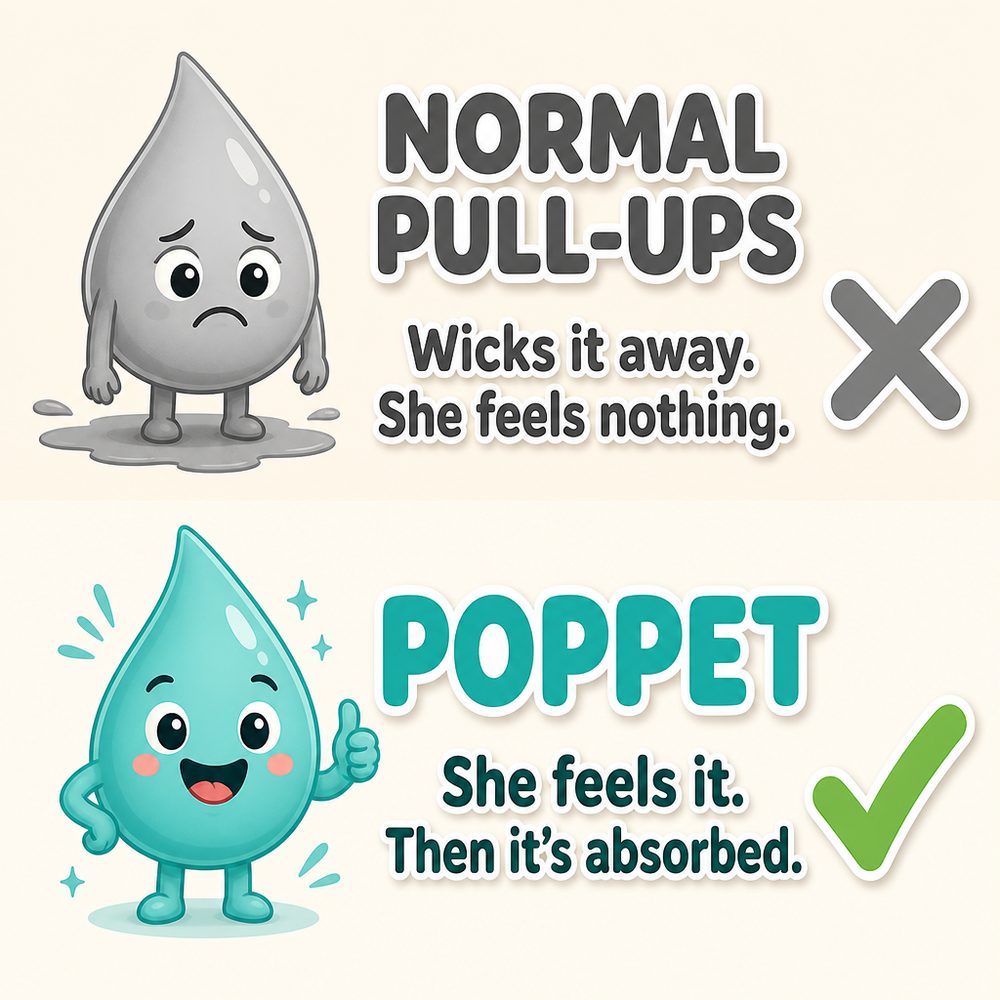
We had spent three years teaching my son to respond to a signal we were wiping away before it ever reached him.
For a child whose signal is already faint, that isn't a small disadvantage.
It's the difference between quiet and silent.
4. What we changed
We stopped trying to teach the signal, and started protecting it.
I switched him into training pants built the other way round. A feel-through inner, so he registers it the moment it happens. The absorbent layer sits underneath rather than in front. A barrier under that, so the couch survives.
It is not a treatment. It did not happen in a weekend. He was five and a half before it properly clicked, and there were plenty of bad weeks after that.
What changed is that we stopped working against him.
If you take one thing from this issue: before you buy another sticker chart, turn the packet over and read the lining.
If it says stay-dry, it is doing the opposite of what your child needs.
See the ones we switched to →
Writes Toddler Tips, a free weekly newsletter for parents in the thick of it. Mum of three, one of whom is autistic and took until five and a half.
Toddler Tips with Laurie is reader-supported. We earn from products we recommend.