I spent four years quietly planning my day around which chairs I could sit on
Nobody talks about this one. You just get very good at standing up a lot, and at finding reasons to. Here is what finally changed it for me — and the very ordinary reason it worked.

The first thing that goes is the dinner table. Not dramatically — you just start getting up between courses. Then you stop suggesting the pub with the wooden stools. Then you find yourself doing the two-hour drive to your daughter's place in three stages, and telling everyone it's because of the traffic.
I had haemorrhoids for the better part of four years. Flare, settle, flare again. The creams did what creams do. I saw a doctor, twice, and got sensible advice about fibre and water that I mostly followed. None of it was the problem.
The problem was chairs. Eight hours a day of them.

What nobody had explained to me is that the treatment and the pain are two different problems. Whatever is going on down there has its own timeline. But the pain — the specific, grinding, all-afternoon kind — is mostly a matter of load. Of what is pressing on it, and for how long.
I had been treating the condition and doing absolutely nothing about the eight hours a day of bodyweight sitting on top of it.
Why a flat seat is the worst possible surface
Sit on something flat and your pelvis rolls backwards. That rotation drives your weight down through the coccyx — the small bone at the base of the spine — and through the soft tissue either side of it. There is almost no muscle or fat over that area. It was never built to carry load, and it certainly wasn't built to carry it for a full working day.
A softer cushion makes it worse, which took me an embarrassingly long time to work out. You sink further in, the pelvis rolls further back, and you land harder on exactly the spot you were trying to protect. I got through three of them.
What actually works is the opposite: something firm, with the material under that area removed entirely. Not cushioned. Removed. If nothing is underneath it, nothing presses on it, and your weight goes out to the sit bones either side — the two thick bones your body is actually designed to sit on.
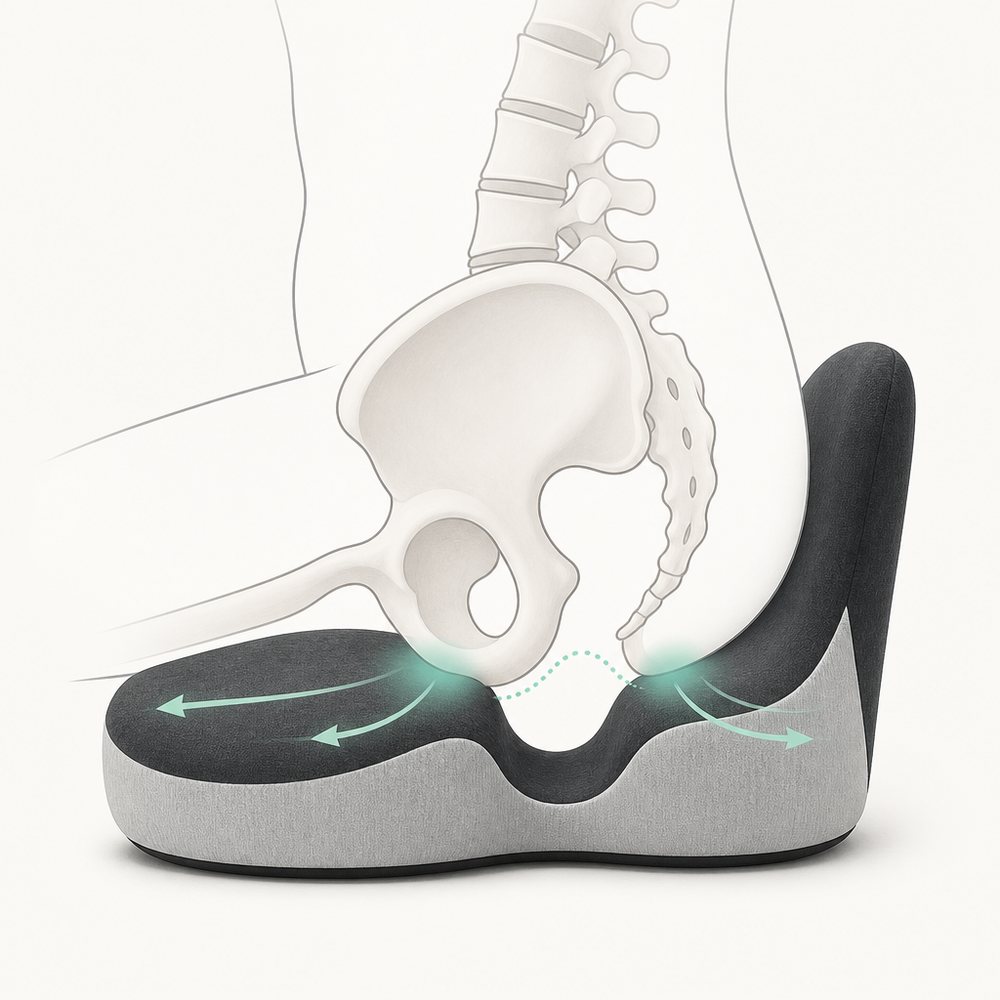

This is the one I ended up with
A firm coccyx-cutout cushion. Plain charcoal, non-slip base, cover comes off and goes in the machine.
See the cushion →Five things I wish someone had told me in year one
Treating it and sitting on it are two separate jobs
Creams, fibre and water address the condition. None of them do anything about the eight hours of pressure. I spent years doing one and not the other and wondered why afternoons were still bad.
Soft cushions make it worse, not better
Every soft one I bought flattened within a month and put me straight back on the tailbone. Firm feels wrong for about a day and then makes complete sense.
A donut ring works — and tells everyone
They genuinely do take the pressure off. They also roll around, they don't support your back, and there is no version of carrying one into an office that goes unnoticed.
The car is the worst chair you own
A car seat is flat, it vibrates, and you cannot stand up in it. If you only fix one seat, fix that one. I keep a second cushion in the boot.
Perching on the edge is not a solution
It's what everybody does, and it just moves the ache into your lower back within about twenty minutes. You end up with two problems.
What the guidance actually says
General advice for this condition consistently includes avoiding prolonged sitting and reducing direct pressure on the area. A cutout cushion is one of the simplest ways to do the second one without having to do the first. It is not a treatment — speak to your doctor about that part.
I am clearly not the only one
I'd been sitting on a folded towel in the van for the better part of a year. Bought one for the van and one for home. The flare-ups still come but the driving stopped being the thing I dreaded.
— Ken W., 58Six weeks after surgery I was still eating dinner standing up. First night with this I sat through a whole meal and didn't think about it once.
— Marguerite D., 54I was quietly avoiding the wooden chairs at my daughter's place. Took this over at Easter and sat through the whole lunch. Nobody said a word.
— Deborah S., 61I am not going to tell you a cushion fixed a medical condition, because it didn't. I still get flare-ups. What changed is that a flare-up is now something I notice rather than something that runs my week.
Four years is a long time to solve the wrong half of a problem.
60 nights to find out if it works for you
A firm coccyx-cutout cushion. Plain charcoal, non-slip base, cover comes off and goes in the machine.
See the cushion →